In appearance, Cate Blanchett is exactly as I imagined her after seeing her so many times on screen, on red carpets, or accepting her two Oscars or her four Golden Globes, to name just a few of the many awards she has accumulated.
I happened to meet her the day after she received her latest award, the one proclaiming her “Champion of Humanity” for her work as a Goodwill Ambassador for the UN Refugee Agency (UNHCR). This award was presented to her at the El Gouna Film Festival, held last October in Egypt, on the shores of the Red Sea, just a few days after the peace agreement was signed in Gaza, a mere hundred kilometers away in Sharm el-Sheikh.
First impressions: I imagined her to be of average height, neither tall nor short, slender, with very fair skin, like a true Australian, and those piercing blue eyes. I also pictured her as somewhat distant, reserved, and very poised. Serenity was the word I would use to describe her. Total calm.
And my feelings don’t change when I see her appear with her team: she’s dressed in white, sneakers included, and wearing a heavy layer of makeup. But, upon greeting me, a handshake and a genuine smile break down the first barrier that only I had erected. She’s not distant. On the contrary, she makes an effort not to be.
Her first time in Egypt
Cate Blanchett laughs when I remind her that it was precisely in Egypt where she first stood in front of a camera. She was 19 years old—she’s 56 now—studying Economics and Fine Arts, and traveling around the country. “I had very little money and ended up staying in a seedy hotel in Cairo. They were printing passports there; the whole thing seemed pretty suspicious. There was a guy recruiting people to be in a boxing movie; they paid five Egyptian pounds and gave you falafel. And I was hungry and had no desire to be an actress. In the end, I ended up in a music video. It was a surreal experience, and they didn’t even give us the falafel, so I quit,” she recalls, laughing.
Her latest projects
So yes, Cate Blanchett laughs heartily; she no longer seems so reserved. And it’s clear she loves talking about her work, which we’ll soon see on screen. First, there’s her role in the film The Elixir of Immortality, a science fiction comedy directed by the Zellner brothers, in which she plays the leader of an alien gang.
Secondly, there’s the play she’s currently filming, written by Alice Birch, “an incredible playwright who worked on the script for the series Succession,” the actress points out. Titled Sweetsick, it sees her playing a woman who is able to see what other people need.
Humanitarian Work
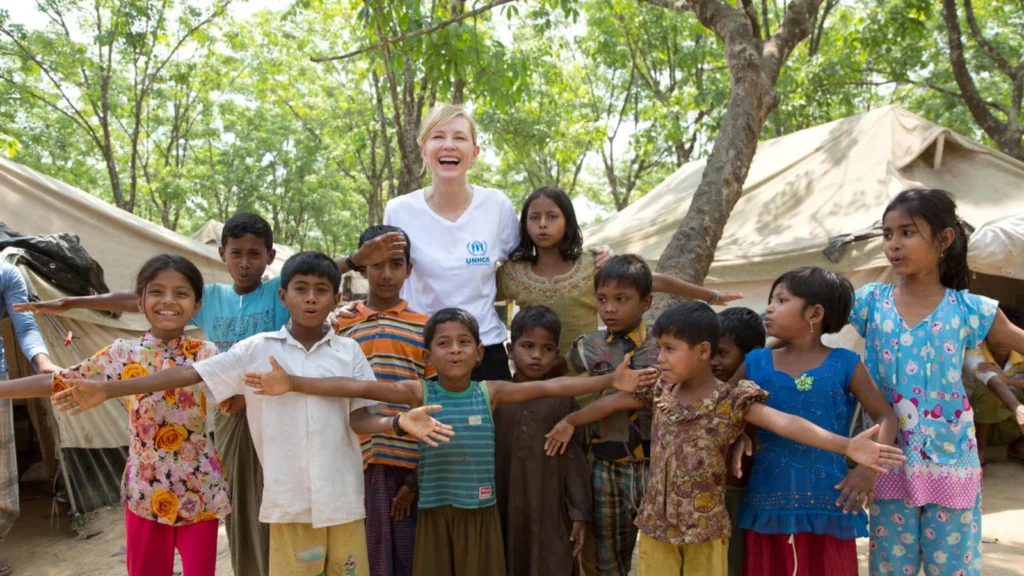
But it’s when she talks about her work with refugees that the extent of her involvement becomes clear, when she gestures and strives to make others understand everything that’s at stake. She begins by praising the host country, Egypt, which currently shelters “more than a million registered refugees and asylum seekers from some 60 nationalities; the vast majority come from Sudan (around 75%), followed by Syrians (approximately 11.5%).”
“It’s very important,” he emphasizes, “to tell the story of countries like this one, caught in a sandwich between, on one side, massive displacement crises, and on the other, the most politicized and violent genocide, and yet they still keep their borders and their hearts open.”
What human story can’t he forget?
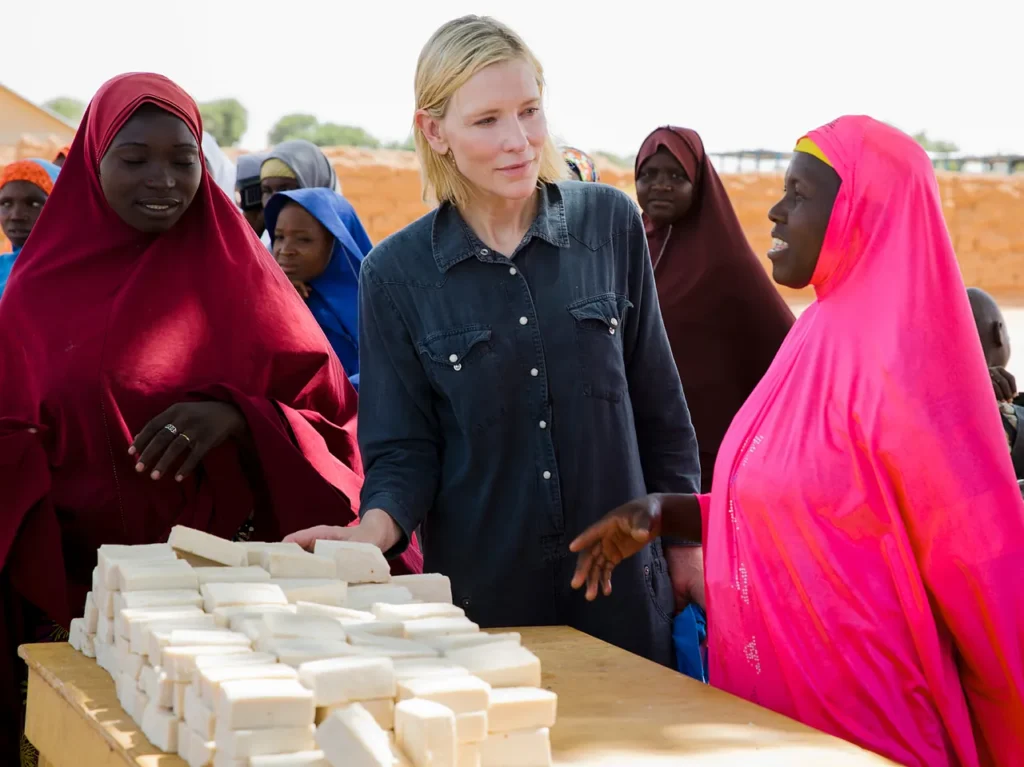
I have four children, so what impacts me most is seeing children in danger. I remember a young Sudanese man, Ibrahim, who was stopped by the police while trying to cross the border into Libya. I was with him, and he told me he had tried to cross six times. I asked him why so many times, and he began to tell me everything that had happened to him, including when they put him in a cage. They were unspeakable situations, brutalities that I can’t even imagine how anyone survives, both physically and mentally. And you realize that these people have no choice. He told me, ‘I died in that cage.’ Everything got worse until he managed to escape and reach Niger.
Ibrahim is Sudanese, the country Cate Blanchett most often mentions when talking about refugees. As I write these lines, UNHCR reports warn of escalating violence that is once again forcing thousands of people to flee their homes. An estimated 26,000 have fled El Fasher, the capital of North Darfur state, in recent days, and more are expected to follow. In addition to fighting, extortion, arbitrary arrests, detentions, and looting, widespread sexual violence against women and girls by armed groups has been reported. The UN agency denounces Sudan as experiencing the world’s largest displacement crisis.
Do you think the emergency in Sudan is a forgotten crisis?
Definitely. I regret that the media only talks about one particular crisis. It’s important, But we must connect them all, because they are interconnected and share common origins. Part of my responsibility as a UNHCR Goodwill Ambassador is to keep all crises in mind and to show that refugees are children, mothers, fathers, siblings, and skilled professionals who are forced to flee. History also connects these conflicts; we have always migrated, and that is how cultures evolve. When a country welcomes vulnerable people with much to offer, its culture evolves in sophisticated ways.
How can our readers help?
You wake up one morning and feel powerless. It even happens to me. But when you encounter xenophobic rhetoric, when you hear falsehoods about refugees and asylum seekers, it is important to investigate what lies behind the person saying it, what they are afraid of. Because all that rhetoric is motivated by fear. So if you try to change their mind, you are not addressing the root of the problem. We need to change people’s mindsets, talk to the person you meet at the store, or your child’s teacher. It can be done like it was done in Australia with tobacco: in primary schools, children were taught how terrible smoking is, and they convinced their parents to quit.
Do artists and film festivals have the power and the responsibility to generate change in society?
I don’t know if they have the power, but they are certainly a platform. And I suppose you can use it to sell shapewear as well as to talk about other things. I’m not on social media, but I do know that it has the potential to connect with people. But it can also be a very passive platform; you like it and forget about it, like you’re on a hamster wheel. The difficult thing is bringing people together in places, getting them to make the effort to go, to be prepared for something, to talk, to actively connect with others.
At this point in the conversation, there’s nothing left of the reserved Cate Blanchett. He gestures, asks if I agree with what he’s saying; it’s clear his arguments come from deep within him. Especially when I ask him if we’re going to leave our children a world worse than the one we inherited. “That’s what keeps me up at night. Because we’re facing the perfect storm, aren’t we?” he replies, adding, “We’re becoming increasingly passive because of the way we consume, the way we obtain information, and even more so with the rise of Artificial Intelligence, which increases that passivity and erodes our sense of reality. If we add to that the geopolitical situation and climate change, we’re in serious trouble. Humans have hit rock bottom as a species.”
Does she truly believe this?
Yes, I do. If you look at the people who govern the world now, you see they have zero imagination. And that’s why I believe the responsibility falls on artists, thinkers, and writers to help people imagine a way out. Part of that begins with realizing that we’re not the only ones who think this way. No, there are thousands of people gathered here who also have that positive energy, but those far-right bastards can’t stand that we’re having a good time. When they have all the toys, they don’t know what to do with them except pick up a hammer and smash them. They can’t create anything. “It’s very worrying.”
After the goodbyes and repeated thank yous, Cate Blanchett gets up and asks someone on her team, “What’s next?” The actress is back.
El Gouna, a destination for film lovers
Cate Blanchett was one of the star guests at the eighth edition of the El Gouna Film Festival, held last October on the shores of the Red Sea in Egypt. Its director, Amr Mansi, is a former squash champion—a sport that’s all the rage in this country. Before the film festival, Mansi created a squash tournament in El Gouna, which in just a few years became “one of the biggest championships in the world.” Following that success, he was offered the opportunity to organize the festival, which focuses on solidarity. His driving force is to show the world that Egypt is more than just pyramids (although it is that too) and that it has much to offer: “I love this country with all my heart,” he says.
With the same pride that Mansi speaks of the film festival, he refers Mohamed Amer, CEO of El Gouna, describes this Red Sea tourist destination, which began its journey 35 years ago and is visited annually by more than a million people attracted “by its fantastic climate, diving, kitesurfing, and many other activities” offered by the area, which now boasts 35,000 residents from dozens of nationalities. “First and foremost, Egyptians,” says Amer, “then British, Germans, Swiss, French, Dutch…”
Amer asserts that the film festival is the biggest event held annually in El Gouna, drawing thousands of people and “acting as an ambassador” for the town.
Published in El Mundo, Tuesday, November 4, 2025