Netflix closed out 2021 with a bang, releasing several highly anticipated holiday films. One of the most talked-about was Don’t Look Up, starring Leonardo DiCaprio alongside Jennifer Lawrence, Jonah Hill, Meryl Streep, and Cate Blanchett.
With a top-tier cast, this film arrived on the platform with a compelling story that could be described as a post-apocalyptic satire, already considered a must-see by many.
Don’t Look Up, starring Leonardo DiCaprio, has already garnered several Golden Globe nominations and is poised to be an Oscar contender.
The film, written and directed by Adam McKay, tells the story of Professor Randal Mindy (Leonardo DiCaprio) and graduate student Kate Dibiasky (Jennifer Lawrence), two not-so-successful astronomers who have discovered an asteroid on a collision course with Earth. And yes, this space rock poses a serious threat to humanity.
However, although they try to alert the U.S. government and the world, neither the authorities, nor the media, and certainly not social media users in general, seem to take the danger seriously. On the contrary, audiences pay attention and focus their concerns on more trivial matters online.
So what will happen? You’ll have to find out by watching the film on Netflix, especially since it’s based on real events (or, as the official tagline says, “based on truly plausible events”). And not only that, but some of its characters are inspired by real-life media personalities.
Who might have inspired the characters in the film?
Below, we’ll review the real-life figures and personalities that may have inspired Don’t Look Up (no spoilers, so you don’t think we ruined the movie for you).
Janie Orleans – Meryl Streep
Meryl Streep plays the not-so-bright President of the United States, Janie Orleans. Given that she’s portraying the top dog in the White House, it was to be expected that director Adam McKay would draw inspiration from one or two American politicians. For many, the biggest reference was Hillary Clinton, and it’s understandable why some people might fall for it.
However, the president’s character in Don’t Look Up is more similar to Donald Trump in many ways. For one thing, Janie Orleans is portrayed as a former television star who, as often happens, leaves show business to pursue a political career, even though she knows absolutely nothing about the field. Something similar happened with the tycoon, who prior to his political career was best known as one of the most famous billionaires in the US, to the point that he appeared as a guest on all kinds of TV shows.
Janie, who in the film dismisses the discovery of the asteroid and the danger it represents, is portrayed as a leader not very close to science and practically lacking interest in intellectual pursuits. This could well be a nod to some of Trump’s own decisions, who at the time downplayed the health emergency caused by COVID-19. And it doesn’t end there. The character portrayed could be a combination of Trump himself and even George W. Bush.
In the film, there’s a scene where Janie proposes an inexperienced, racist sheriff as a Supreme Court justice—a clear nod to the pardon Donald Trump granted in 2017 to former Arizona Sheriff Joe Arpaio, who was accused of negligence, abuse of power, election violations, and more. And regarding Bush, the reference is to the 2005 attempt by the former president to appoint lawyer Harriet Miers to the Supreme Court, even though she had never served as a judge.
Beyond that, Adam McKay himself said in an interview with Deadline that he drew inspiration from many other former presidents, such as Bill Clinton, Barack Obama, and Ronald Reagan, among others.
If Don’t Look Up does anything subtly well in its story, it’s portraying the not-so-unknown practice of nepotism in politics. And Jonah Hill, playing the president’s son, Jason Orlean, takes full advantage of this. This man appears as an important coordinator in the US President’s cabinet, and it soon becomes clear that he is related to Janie by blood.
Jason comes across as someone who isn’t very interested in the political matters that should concern him given his government position. He also comes across as somewhat inept and rather arrogant for what he is. However, he never tires of flattering his mother and highlighting her qualities (even though she isn’t exactly a trustworthy figure either).
If Meryl Streep’s character is some kind of embodiment of Donald Trump, then it’s reasonable to believe that His son Jason is inspired by some of the tycoon’s relatives who had influence in the White House. For many, the direct references would be his daughter Ivanka and her husband, Jared Kushner. On the one hand, Kushner is remembered as one of the men who financed and advised part of Trump’s presidential campaign.
Furthermore, after Trump took office and in the context of the pandemic, he appointed Kushner as one of the supervisors of the national COVID-19 emergency response… needless to say, Jared had no experience handling these matters. And as for Ivanka, she was also part of her father’s advisory team… but there’s more.
As we mentioned, Jason in the film regularly highlights his mother’s qualities—the president’s—even if they are physical. This is a nod to the controversial and almost repeated times Donald Trump has referred to his daughter’s attractiveness in countless interviews. Here’s a weird moment of Trump saying that if Ivanka weren’t his daughter, he’d probably be dating her.
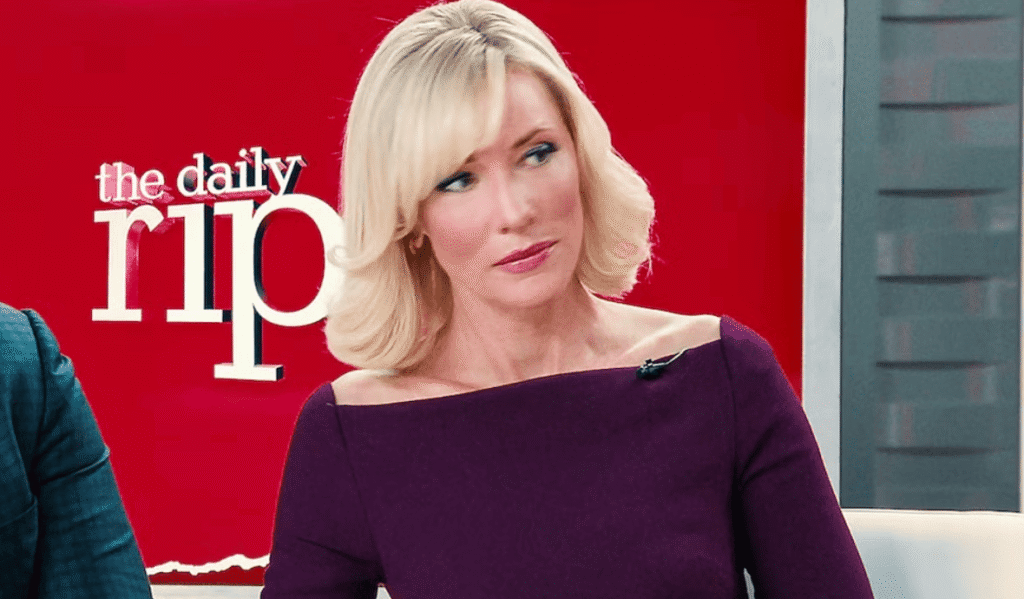
Cate Blanchett as news anchor Brie Evantee
In a comedy as biting as Don’t Look Up, there obviously had to be a significant space dedicated to portraying the media. That role falls to Cate Blanchett, who plays Brie Evantee, anchor of the morning news show The Daily Rip.
And in that sense, Blanchett’s character could be like any American morning news anchor: glamorous figures with ear-to-ear smiles who occasionally crack a witty remark to lighten the mood between news reports. The standard of reference is broad, but director Adam McKay has been asked in some interviews who inspired the character of this news anchor.
Vanity Fair asked McKay if Brie’s character had any nods to NBC’s famous Morning Joe host, Mika Brzezinski. The filmmaker said, in any case, that the similarities between Evantee and Brzezinski were purely coincidental… although they are quite specific, especially regarding the host’s access to the upper echelons of the US government (because, in case you didn’t know, Mika Brzezinski grew up in the political arena thanks to her father, who served as an advisor to Presidents Jimmy Carter and Lyndon B. Johnson).
A reference to The New York Times
Speaking of media, and in case you’ve already seen the film, you’ll remember the appearance of a newspaper called the New York Herald. Here, McKay did tell Vanity Fair that it’s a direct reference to The New York Times and its altruistic image. But there’s another very interesting detail.
According to the film’s director, this could be a critique of the New York Times for its well-known editorial altruism, which contrasts sharply with the 2017 hiring of Bret Stephens, a well-known author with neoconservative leanings, a right-wing political sympathizer, and a staunch climate change denier.
This point is important because, while the film addresses the threat of a meteorite, it’s a clear reference to how the media has largely ignored the causes and consequences of climate change. Subtle, but direct.
Are there references to Elon Musk, Apple, and Mark Zuckerberg?
Just as the media and the US government are central to the plot of Don’t Look Up, the film also targets the business sector. In this regard, the satire of the big names in the tech industry is evident through the character of Peter Isherwell (played by Mark Rylance).
In the film, Isherwell is the owner of the technology company Bash, known, among other things, for releasing high-end smartphones every year. A key characteristic is that this tech magnate is portrayed as a figure admired almost religiously by his customers and others. The allusion is clear: Bash represents Apple, and Peter is a Steve Jobs who’s overly involved in politics.
This trait of the character—his involvement in government affairs and his almost messianic image in the tech world—could very well be a reference to Elon Musk and his countless companies like Tesla, SpaceX, and so on. You know, because his discourse always implicitly includes leading humanity to new heights as a civilization.
And, well, the film also shows Peter Isherwell using his technology to access and track personal information. That could very well be a nod to Facebook (now Meta) and the various accusations leveled against Mark Zuckerberg for allegedly having access to users’ personal data through his platforms (FB, WhatsApp, Inst)